
Blue Team Cyber Range Playbook: Attack Paths, Injects, and After-Action Reviews
What Is a Blue Team Cyber Range Playbook?
Strong blue team cybersecurity does not grow from slide decks and long meetings. It grows from practice under pressure, in a safe place where mistakes do not take down real systems. That is exactly what a cyber range gives you, especially when attacks spike and critical systems are under stress.
A cyber range is a realistic training ground for defenders. It is where teams can rehearse complex incidents, tune alerts, and push their tools and playbooks to the breaking point without risking production. In this guide, we will walk through how to design attack paths, build good injects, and run after-action reviews that actually change how your team responds the next time things get loud.
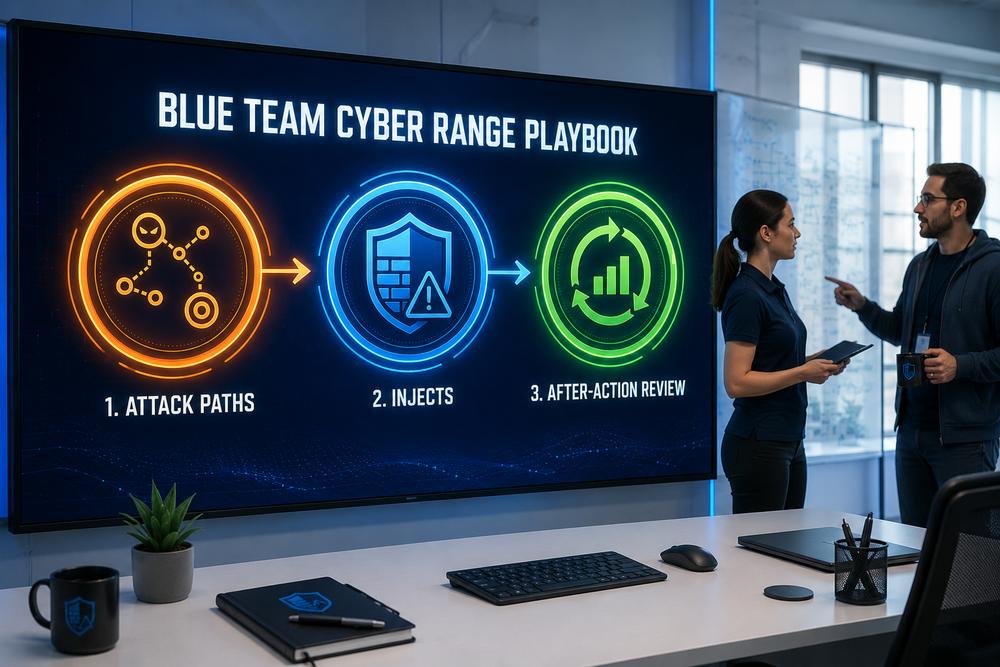
A blue team cyber range playbook is a structured guide for planning, running, and improving defensive cybersecurity exercises. It defines the training objectives, attack path, scenario injects, facilitation roles, safety rules, success metrics, and after-action review process so defenders can practice realistic incidents in a controlled environment.
High-demand periods bring heavier workloads, more distractions, and more opportunities for attackers to test tired or short-staffed teams. Cyber range scenarios give defenders a safer way to practice those high-pressure moments before they happen in production.
Start with Clear Training Outcomes and Realistic Threats
Good scenarios start with a simple question: what do we want people to be better at when this is over? If the answer is fuzzy, the scenario will be fuzzy too. Before anyone logs into a console, write down the specific skills you are trying to grow.
Common training outcomes include:
Sharpening SOC triage and escalation Validating incident response runbooks Testing threat hunting ideas or new detections Onboarding newer analysts into blue team roles
Once objectives are clear, match them to realistic, current threats. Think about what your organization actually faces. For many teams, that looks like:
AI-assisted phishing that creates believable lures Supply chain attacks delivered through trusted software or partners Identity-focused attacks that target MFA fatigue and session tokens OT and ICS threats that hit during high-demand operational periods
Next, match scope and difficulty to who is in the room. A solo learner working on a career shift may need a focused, single host scenario. An enterprise team might need a full, noisy network with cloud and on-premises systems. Government teams may need mission-level exercises that blend IT, OT, and public communication.
Define what success looks like up front. Helpful metrics include mean time to detect, mean time to respond, how well people followed or improved the playbook, and how clearly they communicated under pressure. If you do not measure these, it is hard to show progress from one scenario to the next.
Design Attack Paths That Feel Like the Real World
Real attackers do not follow clean lab scripts, but you can still model their behavior in a structured way. Frameworks like MITRE ATT&CK can help you map likely adversary tactics and techniques from initial access to impact. Use them as a menu, not a rulebook.
When you build an attack path, think in stages:
Initial access, such as phishing, exposed services, or stolen credentials Execution and persistence on the first host Privilege escalation to higher-level accounts Lateral movement into servers, cloud, or OT systems Data access, exfiltration, or disruptive actions
For example, you may start with a phishing email that drops malware that steals credentials, which are then used to access cloud resources, which finally leads to data exfiltration. Each hop should touch different tools and teams, so defenders must correlate across email, endpoint, identity, and network.
Start small, then grow. Many teams do well beginning with a single host ransomware event or a simple web shell on one server. As skills rise, expand into cross-domain scenarios, hybrid cloud environments, and remote work setups that match how people really connect. In a place like Florida, where storms can disrupt power and push more users remotely, scenarios that mix VPN access, home networks, and cloud services are especially helpful.
Craft Injects That Drive Analyst Decisions Under Pressure
A cyber range scenario without injects feels flat, like watching logs slowly scroll. Injects add drama and choice. They are timed or conditional events that force your blue team to prioritize, decide, and act.
Think of injects as mini prompts. Each one should have:
Objective: what decision or skill are you testing? Trigger: when does it fire, by time, event, or performance? Content: is it technical, non-technical, or a mix?
Examples of inject types include:
Security alerts, IDS hits, or EDR pop-ups Log snippets, packet captures, or forensic images User reports of strange behavior or suspected phishing Threat intel notes hinting at known groups or TTPs Media or leadership inquiries that test communication
Good scenarios balance noise and signal. If every alert points straight at the answer, analysts do not learn to filter. Mix in false positives, partial data, and alerts from multiple tools so the team must correlate, ask questions, and lean on playbooks instead of gut feelings. The goal is not to trick people but to help them practice good judgment under pressure.
Run the Scenario with Strong Facilitation, Tooling, and Safety
Even the best scenario design falls flat without the right people running it. Most cyber range events work best with clear roles:
White cell: controls the exercise, facilitates the scenario, keeps time, and manages injects. Red cell: runs the attack path and adapts as needed. Blue cell: defends using assigned roles, tools, and playbooks.
Brief everyone before you start. Set expectations, share the high-level goal, and explain any safety limits. During the exercise, white cell and red cell should watch for learning moments, such as repeated confusion or a detection that no one notices. They can nudge things gently without breaking immersion.
On the tooling side, options range from full commercial cyber ranges to cloud-based lab setups that copy your network patterns. The key is that the environment is safe, segmented, and disposable. You want people to feel free to try bold actions without breaking real systems.
Safety and governance matter as much as realism. Set clear rules of engagement, such as what is allowed on endpoints and accounts. Have strict data-handling rules, so logs and captures do not expose real user data where they should not. Plan rollbacks in advance, so you can reset systems quickly between runs and avoid any cross-contamination with live networks.
Turn After-Action Reviews Into Lasting Capability Gains
Training value does not end when the last alert is closed. The real payoff comes in the after-action review. This is where you turn a busy day into real, long-term gains in blue team cybersecurity.
A simple, reliable flow looks like this:
Recap objectives and what the scenario was meant to test Rebuild the timeline from first malicious action to final recovery Walk through key decisions and turning points Compare actual actions to playbooks and policies
During this review, capture lessons in clear buckets, such as gaps in visibility, missing detection rules, clumsy tooling workflows, unclear roles, or poor communication paths. Each item should turn into a concrete task with an owner and a target date, not a vague note that sits on a slide.
Finally, close the loop. Update playbooks, tune rules, fix dashboards, and change training plans based on what you learned. Then schedule follow-up scenarios to test those fixes. Over time, this cycle turns your cyber range from a one-time event into a steady driver of blue team maturity.
At Applied Technology Academy, we build instructor-led cyber range experiences around this kind of continuous improvement. Our focus is always on real-world, hands-on practice that helps individuals, teams, and government missions stay ready for the next spike in attacks.
FAQ
What is a blue team cyber range playbook?
A blue team cyber range playbook is a structured guide for planning and running defensive cybersecurity exercises. It defines the scenario objectives, attack path, injects, roles, tools, rules of engagement, success metrics, and after-action review process.
What are cyber range attack paths?
Cyber range attack paths are the planned steps an adversary follows during a scenario, such as initial access, execution, privilege escalation, lateral movement, data access, exfiltration, or disruption. They help defenders practice investigating and responding to realistic incidents.
What are injects in a cyber range exercise?
Injects are timed or conditional events added during a cyber range scenario to prompt decisions and actions. Examples include security alerts, log snippets, user reports, threat intelligence updates, leadership requests, or media inquiries.
Why are after-action reviews important in blue team training?
After-action reviews help teams turn a cyber range exercise into measurable improvement. They identify what happened, what worked, what failed, which playbooks need updates, and what actions should be assigned before the next exercise.
Who should use a blue team cyber range playbook?
A blue team cyber range playbook is useful for SOC analysts, incident responders, threat hunters, security leaders, government cyber teams, and organizations that want to improve defensive readiness through realistic hands-on practice.
Advance Your Defense Skills With Expert Blue Team Training
If you are ready to strengthen your security career, our blue team cybersecurity programs give you hands-on skills to detect, respond to, and contain real-world threats. At Applied Technology Academy, we focus on practical labs and instructor-led guidance so you can confidently perform in high-stakes environments. Talk with our training advisors to map the best course path for your goals by using our contact page. Start now so you can be better prepared for your next role or certification exam.