When Cyber Ranges Offer More Than a Home Lab
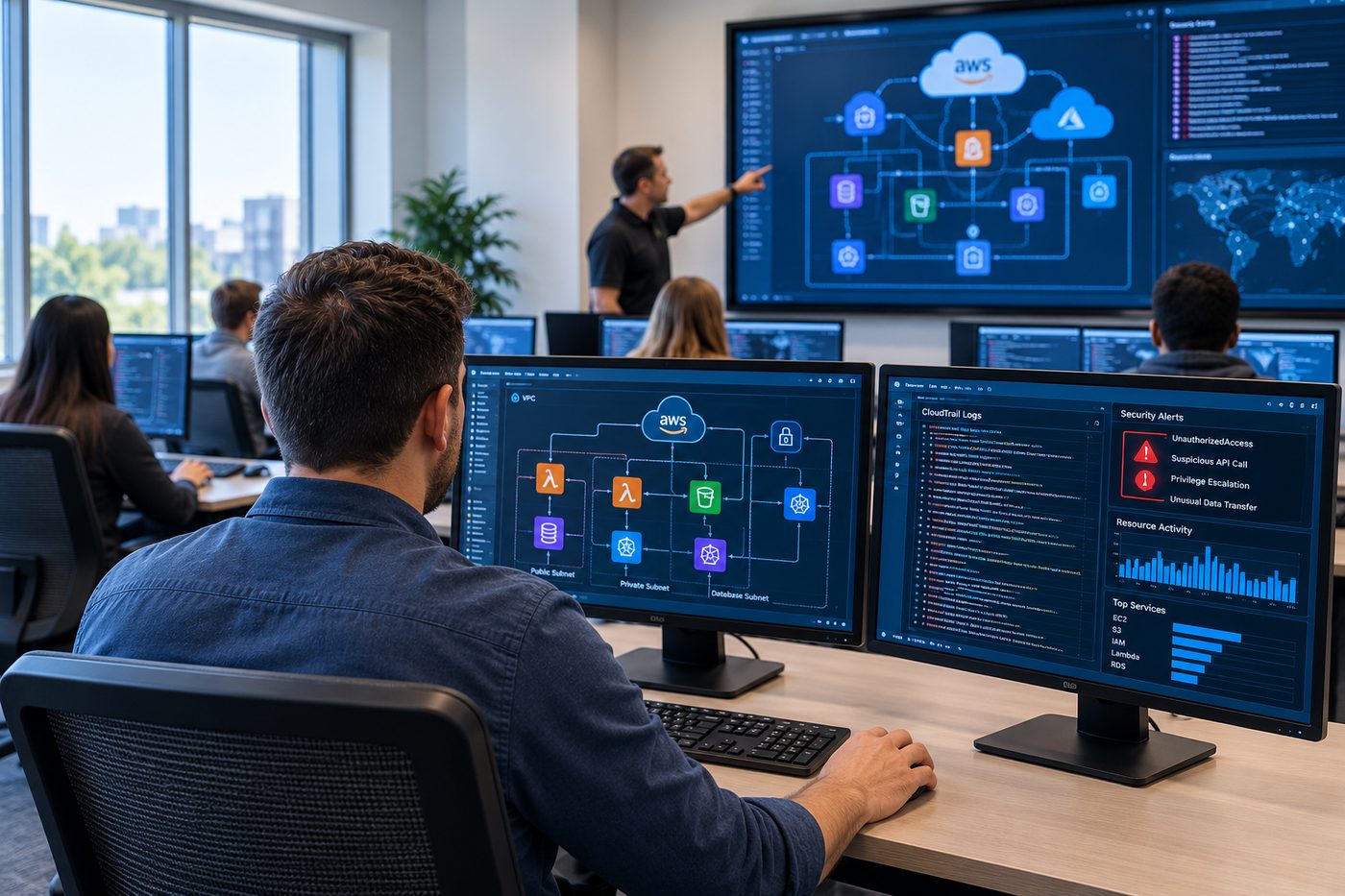
Home labs and cyber ranges can both build valuable cloud security skills, but they serve different purposes. Home labs are useful for learning fundamentals, experimenting with cloud services, and practicing environment setup. Cyber ranges become especially valuable when learners need realistic scenarios, isolated environments, repeatable exercises, instructor guidance, or team-based training.
For cloud security training, that difference matters. Modern cloud environments can involve multiple accounts, complex identity and access management (IAM), containers, serverless workloads, centralized logging, and interconnected services. Reproducing that complexity independently can require significant time, cost, and configuration.
In this article, we'll compare cyber ranges vs. home labs for cloud security training, explain where each approach works best, and help you decide when it makes sense to move beyond a DIY lab.
Where Home Labs Can Fall Short for Cloud Security Training
Home labs can be excellent for learning cloud fundamentals, testing configurations, and gaining experience building environments from scratch. Their limitations become more noticeable when learners try to reproduce the scale, complexity, and interconnected systems found in enterprise cloud environments.
Depending on the learner's time, budget, and experience, a DIY environment may not include:
- Multiple cloud accounts or subscriptions with complex trust relationships
- Hybrid architectures connecting cloud and on-premises resources
- Containerized and serverless workloads
- Complex IAM policies, privilege paths, and organizational guardrails
- Centralized logging and security monitoring across multiple services
Practicing only in a simplified environment can make it harder to develop experience with the complexity of enterprise cloud security. Real-world environments may involve interconnected identity paths, multiple data sources, and security events that require investigation across several systems.
There is also the safety problem. Many learners test tools in personal cloud accounts, home networks, or random test servers. That can go wrong fast:
- Surprise bills from leaving test resources running
- Accidentally exposed cloud services or overly permissive access policies
- Data you did not mean to share sitting in a public bucket
- Tools or scripts that are not safe to run on your main PC
On top of that, home labs eat time. You spend hours:
- Spinning up virtual machines and accounts
- Patching systems and updating tools
- Chasing broken configs instead of learning security skills
How Cyber Ranges Deliver Real-World Cloud Security Training
Cyber ranges flip that script. Instead of you trying to build a fake mini company at home, the platform can provide a purpose-built environment designed to simulate realistic cloud security scenarios.
Depending on the platform and training objective, cloud-focused cyber ranges may include:
- Multi-account or multi-subscription cloud environments
- Hybrid network architectures
- Complex IAM roles, policies, and privilege paths
- Containers, serverless applications, and modern cloud workloads
- Security monitoring, logging, and incident response tools
The National Institute of Standards and Technology (NIST) defines a cyber range as a safe environment for hands-on, realistic training, scenarios, challenges, and exercises.
Well-designed cyber range scenarios can be built around realistic cloud attack paths, including identity abuse, privilege escalation, exposed resources, insecure configurations, and weaknesses in modern cloud applications.
The best part is safety. In a range, you can:
- Run powerful offensive tools without risking your own data
- Trigger alerts, misconfigurations, and even full-on breaches
- Make mistakes that would be scary in a live environment
Those mistakes become learning moments instead of incidents. Guardrails keep you inside a controlled space so you can push harder and explore more.
Cyber ranges also include structure on top of the playground. Instead of random clicking, you follow guided paths:
- Fundamental cloud security labs that build a base
- Intermediate challenges that blend red and blue skills
- Advanced incident response, threat hunting, and team events
Many cyber range platforms also provide scoring, progress tracking, flags, or performance analytics. You can see where you spent time, what you missed, and where you improved. That kind of feedback turns practice into progress.
Cyber Ranges vs. Home Labs: Which Is Better for Cloud Security Skills?
Neither option is automatically better. The right choice depends on what you need to practice.
A home lab may be the better choice when you want to:
- Learn how cloud resources are created and configured
- Experiment independently at your own pace
- Practice foundational cloud administration and security
- Build troubleshooting skills by creating the environment yourself
A cyber range may be the better choice when you want to:
- Practice realistic attack and defense scenarios
- Work in complex environments without building them yourself
- Repeat scenarios without rebuilding infrastructure
- Train with instructors or teammates
- Measure performance against defined objectives
For professionals with limited training time, cyber ranges can also reduce the infrastructure setup and maintenance required before meaningful practice begins.
Both approaches can give you useful experiences to discuss with employers. A home lab can demonstrate initiative and your ability to build and troubleshoot an environment independently. Structured cyber range exercises can provide examples of how you investigated incidents, worked through attack paths, or responded to realistic scenarios.
The strongest portfolio may include both: evidence that you can build and understand cloud environments yourself and experience applying security skills in structured, realistic scenarios.
How Applied Technology Academy Uses Hands-On Cloud Security Training
At Applied Technology Academy, instructor-led training combines technical instruction with hands-on practice so learners can apply concepts instead of only reading or hearing about them.
A typical cloud security training experience with a cyber range includes:
- Hands-on IAM work, like tuning roles and hunting privilege issues
- Log review and alert handling, from basic events to active attacks
- Full incident walkthroughs, from first alert to final remediation
You are not just clicking through tasks. You are thinking like an attacker and a defender, often in the same scenario.
Mentoring is a big part of the picture too. As you progress through cyber range scenarios, we help you line that experience up with certification goals and career paths. Whether you want to become a cloud security engineer, architect, or analyst, we focus your practice on the skills that match those jobs, not random tricks.
When Should You Move From a Home Lab to a Cyber Range?
You do not have to abandon your home lab to benefit from cyber range training. The two approaches can complement each other.
A home lab is valuable for building fundamentals, experimenting independently, and learning how cloud environments work from the ground up. A cyber range becomes especially useful when you need greater complexity, realistic attack scenarios, repeatable exercises, instructor guidance, team-based practice, or structured performance feedback.
If your home lab is no longer challenging you—or you are spending more time maintaining the environment than practicing security—a cyber range may be the logical next step.
The goal is not to choose one environment forever. It is to use the training environment that best matches the skill you are trying to build.
Frequently Asked Questions About Cyber Ranges vs. Home Labs
Are cyber ranges better than home labs for cloud security training?
Not always. Home labs are useful for learning fundamentals, building environments, and experimenting independently. Cyber ranges can offer an advantage when learners need realistic scenarios, greater infrastructure complexity, repeatable exercises, instructor guidance, or team-based training.
Are cyber ranges safe for cybersecurity training?
Cyber ranges are designed to provide isolated environments where learners can practice cybersecurity techniques without affecting production systems. NIST describes cyber ranges as safe environments for realistic hands-on cybersecurity training and exercises.
Can a home lab teach cloud security?
Yes. A home lab can be an effective way to learn cloud configuration, IAM, networking, logging, and security fundamentals. Its limitations generally depend on the learner's budget, available time, technical experience, and ability to reproduce complex environments.
When should I switch from a home lab to a cyber range?
Consider adding cyber range training when you need scenarios or infrastructure that would be difficult to build yourself, want structured or instructor-led exercises, need team-based practice, or want to repeat realistic security scenarios in an isolated environment.
Advance Your Cloud Security Skills With Role-Focused Training
If you are ready to build stronger cloud security skills through hands-on practice, explore our cloud security training programs at Applied Technology Academy. Our instructor-led courses help learners connect technical concepts with practical exercises and real-world cybersecurity scenarios. Explore upcoming training or contact our team to discuss the learning path that best fits your goals. .